BIOWA is a Beninese feminist organization committed to the rights of women and girls—from their reproductive health to their economic and bodily autonomy.
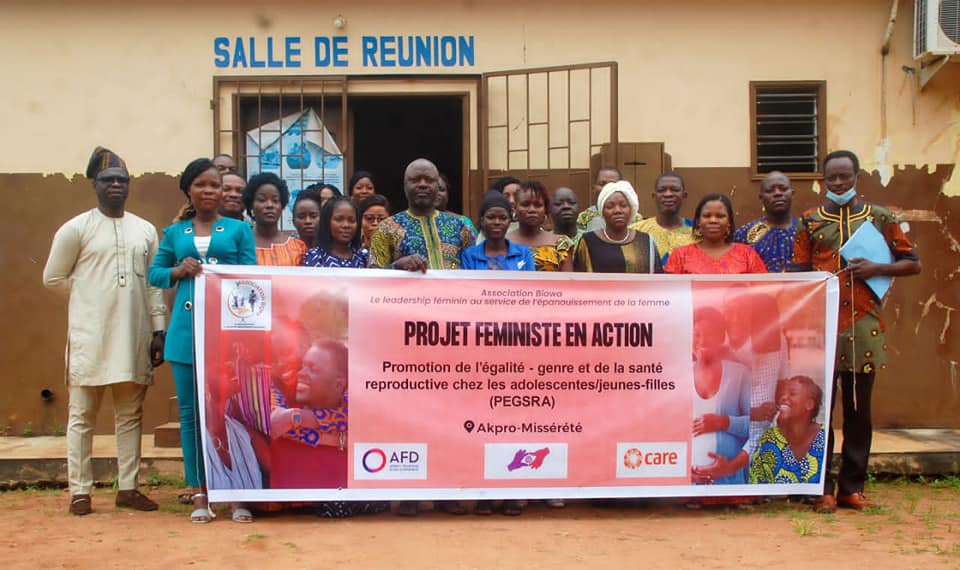
With support from Féministes en Action, the organization is implementing the Project to Empower Girls and Young Women Aged 10 to 35 Through Rights and Sexual and Reproductive Health (SRHR) in the Ouémé and Plateau departments.
On the occasion of March 8, CARE France met with its president, Lucrèce AVAHOUIN, who shared with us the initiatives her organization is most proud of.
Women and Girls in Benin: Between Rights and Reality
In Benin, a girl’s fate is often decided very early on. One in five girls (aged 15 to 19) is pregnant with her first child or has already given birth. These figures reflect the persistent weight of social norms that make marriage and motherhood the primary focus of women’s lives. It is common for young girls to enter a “union” before the age of 18, a term that encompasses both formal marriage (civil, religious, or traditional) and stable cohabitation with a partner.
Law sets the minimum age for marriage at 18 and explicitly condemns forced marriages. However, the practices of early and/or forced marriages remain common as they are fueled by traditions and community pressures. Approximately 14% of women aged 25 to 49 were already living in a union before the age of 15.
Although Beninese law guarantees every person the right to be informed and to freely choose their method of family planning, a significant gap persists between the legal framework and its effective implementation. Nearly one-third of women report an unmet need for family planning.
Speaking out, taking back control of one’s life
For BIOWA, bringing about change begins with creating an environment where people can speak freely. At the heart of this Beninese organization’s feminist identity lies a core belief: women and girls must be empowered to move from being “victims” to becoming “agents” of their own change.
“Effectively engaging girls and adolescents in positive sexual health means creating spaces where their voices are valued.”
It is in this spirit that BIOWA, with the support of the Feminists in Action project, collaborates with two partner organizations— CAMEF, and ONESIME. The activities they carry out together aim to bring about lasting change in society as well as for the project participants.
Among the key initiatives are educational discussions, which are sessions for open dialogue on often taboo topics.
“This project has helped break the silence surrounding sex education: discussions about periods, contraception, and consent—topics that are often off-limits.”
Lucrèce observes a real transformation in the participants: a renewed sense of confidence, a newfound ability to express themselves, and above all, the courage to speak out against violence.
This momentum continues through the training of young SRHR ambassadors, who in turn become advocates, leading discussions, mentoring sessions, and reflections on the sociocultural norms that hinder access to reproductive health services.
To reach the most remote areas, the project also deploys the Girls on the Move mobile clinics, which offer consultations, contraception, and STI screenings.
BIOWA’s strength, its president emphasizes, lies in a co– hip with the beneficiaries themselves—a hip conducted in local languages and within spaces where they feel safe.
In Benin, transforming the daily lives of girls and young women is a long-term endeavor. Every space for dialogue created, every taboo broken, every support journey undertaken is a step forward. The challenge that BIOWA, CAMEF, and ONESIME have undertaken is a significant one: to make the empowerment of women and girls not a distant ideal, but a reality rooted in communities. By placing women at the center of their own transformation, the organization demonstrates that another path is possible—and that it is already opening.
About BIOWA: BIOWA is a Beninese women’s organization that advocates for the rights, health, and empowerment of girls and women. It fights against violence, promotes gender equality, and supports vulnerable women in their socio-economic development.