Feminists in Action supports four Salvadoran feminist organizations that carry out projects to support victims of gender-based violence (GBV), promote sexual and reproductive health, and create participatory spaces to connect and strengthen the feminist movement in El Salvador.
For the past year, these organizations and many others have faced increasing restrictions imposed by the state and its Ley de Agentes Extranjeros (Foreign Agents Law). Amid almost total media silence, the law’s enforcement has curtailed the work of feminist and activist groups.
A Law Passed Without Public Debate
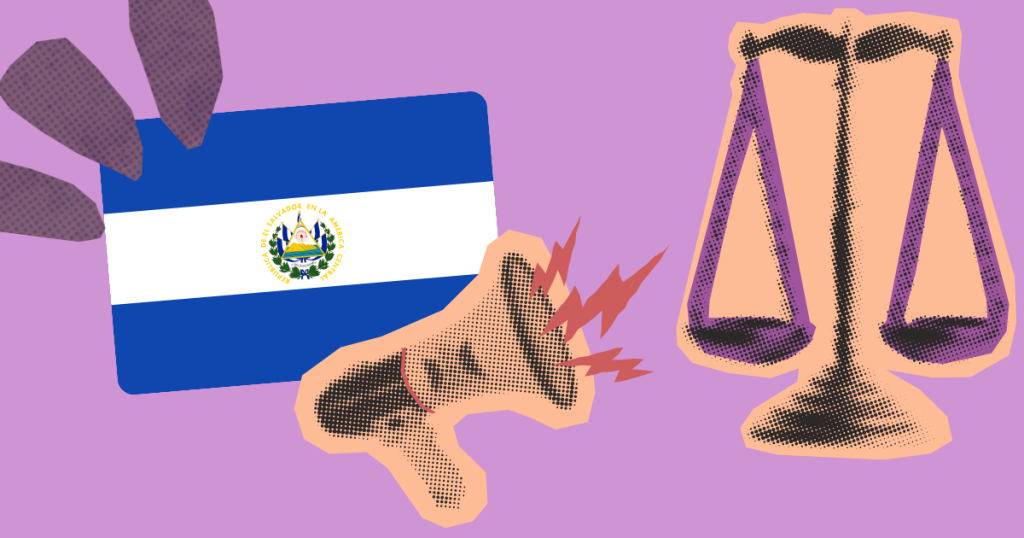
On May 20, 2025, the Legislative Assembly adopted the “Ley de Agentes Extranjeros” without public debate. Presented as a tool to combat corruption and ensure transparency in foreign funding, this law actually imposes severe restrictions on the freedom of action of civil society organizations.
Its effects are particularly concerning for feminist organizations. On the one hand, there is no independent state institution to guarantee protection against the state’s criminalization of civil society. On the other hand, the law requires any organization receiving international funding—directly or indirectly—to register with the RAEX, the Registro de Agentes Extranjeros (Register of Foreign Agents).
A Tax Burden That Stifles Organizations
Organizations registered with the RAEX may be subject to a 30% tax on certain funds received from abroad. The consequences can be severe: registered organizations find their ability to act severely limited and face increased state surveillance. Conversely, those that refuse to register risk being deprived of international funding.
According to information provided by the Concertación Feminista Prudencia Ayala (CFPA), the application of this tax is not uniform across all projects or initiatives funded by international sources. However, the lack of clarity in certain administrative procedures and the broad scope of interpretive powers are causing concern among organizations, particularly in areas related to human rights defense, citizen participation, and advocacy.
This uncertainty leads to delays in project planning and implementation, which complicates decision-making and jeopardizes the sustainability of initiatives that depend on international cooperation.
A Model Inspired by Authoritarian Regimes
As Human Rights Watch and Amnesty International have pointed out, similar laws have already been enacted in countries such as Russia, Nicaragua, and Venezuela, with the aim of controlling organizations perceived as critical of the government. Amnesty highlights the spread of so-called “anti-NGO” laws in Central and South America, which are based on similar logic: the designation of an external enemy, vague provisions, and arbitrary oversight mechanisms.
In El Salvador, this law could have repercussions on freedom of association, civic participation, and access to resources from international cooperation. The feminist and human rights organizations consulted believe that this law is part of a broader trend toward tighter controls on civil society.
For organizations such as the CFPA, this situation calls for strengthening mechanisms for risk assessment, institutional protection, and coordination among social actors. Faced with a constantly evolving context, the organizations continue to develop strategies to carry out their work of providing support, promoting rights, and strengthening the participation of women and communities.
A Civic Space Under Threat
In light of the new and increased risks to which this law exposes feminist and human rights organizations in El Salvador, CFPA states that:
“As part of our collaborative efforts, we have held discussion sessions on the risks we face in the activities we carry out, and we have developed plans for each of the risks we have identified through consensus.”
Ultimately, this law not only has a significant financial impact on NGOs—particularly feminist organizations already weakened by limited access to funding—but its effects are even more pronounced on the political and social fronts. It is part of a broader trend of criminalization, surveillance, online harassment, and forced exile targeting activists, journalists, and human rights defenders in El Salvador.
Rather than serving as a tool for transparency, this law appears to be an instrument for controlling and restricting civic space, which—in a country where fundamental rights such as sexual and reproductive rights are violated—worsens the situation of the population and highlights the vital role of human rights organizations.